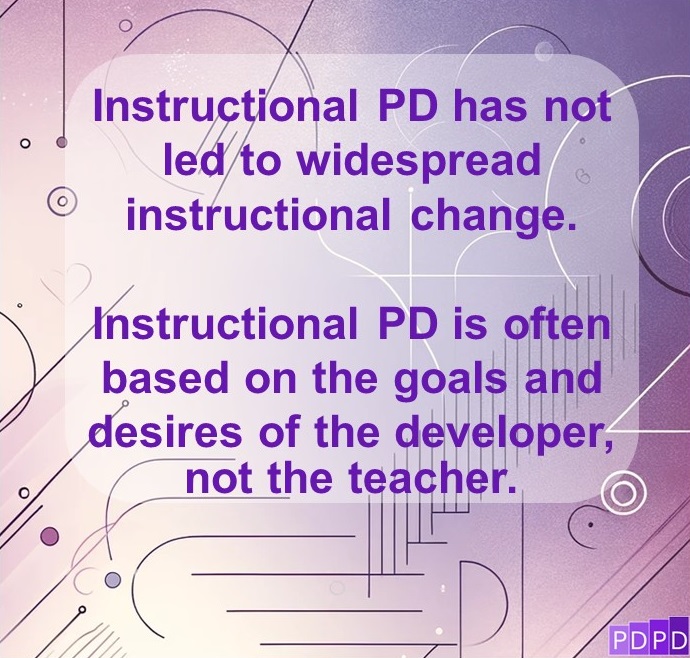
Having worked in professional development (PD) with math teachers for a collective 40+ years, we’ve detected a possible paradox and a concerning contradiction in our field. The paradox is that there are many excellent PD efforts going on and have been for decades, with many reports of success in the literature, but math instruction itself is largely unchanged (at least in the U.S.). For decades math instruction has remained rooted in procedural-focused, teacher-centered patterns. From a broad view, the many specific PD successes have not accumulated into general success.
The contradiction is that professional developers and teacher educators often emphasize to teachers that it is important to honor and build upon the knowledge and experiences, as well as the community and culture, that students bring with them into their learning. Yet, those same professional developers (including ourselves in the past) tend to center our own goals and visions for what we think instruction should be, and it is often quite distinct from conventional instruction. We put in a lot of effort—building relationships, leveraging resources, showing demonstrations, leading simulations, etc.—all to try to replace aspects of the teacher’s pedagogy (or their entire pedagogical model) with our own. Teachers’ current practice, their school’s traditional curriculum materials, the student and parent expectations, and the assessment regime all tend to be viewed as barriers to overcome.
It’s possible that the contradiction partially explains the paradox. Because we have not built on teachers’ and schools’ current realities, we have been unsuccessful in spurring widespread instructional change. Said another way, if we build on teachers’ visions of instruction rather than our own, and if we aim toward modestly improving each teacher’s instruction rather than promoting a profoundly different form of instruction, then our specific PD successes may be able to sustain with teachers and spread to others.1
Some people may not view this paradox and contradiction in the same way we do.2 It is, admittedly, a very complex domain, with intersecting systems and factors at play. But we have found it motivating as we work toward one possible approach for trying to resolve the paradox and contradiction, and that approach is incremental PD. Incremental PD is PD that does not involve a large investment of time or money on the part of the teacher (or school) and which seeks to promote modest suggestions for instructional improvement that can be readily taken-up by teachers (Otten et al., 2022). Examples of these suggestions, which we have come to call “instructional nudges,” would be (a) asking a teacher to delay their lecture by 3 minutes so students can first try a key problem from the day’s lesson, (b) encouraging teachers to place worked examples side-by-side on the board instead of one at time, or (c) breaking up independent work time by pausing to allow students to discuss a problem in progress. (Other sample nudges were shared at AMTE 2023.) There are many, many possible instructional nudges and we are working on a multi-year project to study what sorts of nudges are preferred by math teachers and how the nudges work out in the classroom.
The sharing of nudges, as a form of incremental PD, is modest but is nevertheless aimed at effective and equitable instruction. The strategy is to promote easy-to-incorporate instructional improvements that have a chance of becoming widespread. This approach contrasts with PD that leads with notions of reform-oriented, significantly-transformed mathematics instruction, which we refer to as transformational PD. (To be clear, incremental PD over time can accumulate and lead to noticeable transformations in practice, but, as is described in a separate post, incremental PD as we conceive it is driven by the realities of practice, not by the idealism of a new form of instruction.) In the past, we’ve been involved in many transformational PD efforts, and we still root for those who are continuing to pursue transformational PD. If someone is working with teachers and in a context where there is a high likelihood of transformational success, then we say go for it! But in thinking broadly about our field, we have come to believe that transformational PD should have a complementary approach.
In the next two posts, we briefly lay out 4 of the reasons we think transformational PD has been unsuccessful in yielding widespread instructional change. Then we describe 6 reasons that, in our view, incremental PD is worth trying.
–Samuel Otten, Zandra de Araujo, Amber G. Candela, & F. Paul Wonsavage
Suggested citation:
Otten, S., de Araujo, Z., Candela, A. G., & Wonsavage, F. P. (2024, May 30). Mathematics teacher PD: A paradox and a contradiction walk into the classroom. Practice-Driven PD. https://practicedrivenpd.com/2024/06/13/mathematics-teacher-pd-paradox-and-contradiction/
Part 1: Mathematics Teacher PD: A Paradox and a Contradiction Walk into the Classroom
Part 2: Why Transformational PD Hasn’t Worked at Scale
Part 3: Why Incremental PD is Worth Trying
Podcast Episode Discussing These Ideas
Selection of References Informing Our Views
Cortina, J. L., & Višňovská, J. (2023). Designing instructional resources to support teaching. In T. Lamberg & D. Moss (Eds.), Proceedings of the forty-fifth annual meeting of the North American Chapter of the International Group for the Psychology of Mathematics Education (Vol. 1, pp. 15-26). Reno, NV: University of Nevada. http://www.pmena.org/pmenaproceedings/PMENA%2045%202023%20Proceedings%20Vol%201.pdf
Desimone, L. M. (2011). A primer on effective professional development. Phi Delta Kappan, 92(6), 68-71. https://journals.sagepub.com/doi/full/10.1177/003172171109200616
Goldsmith, L. T., Doerr, H. M., & Lewis, C. C. (2014). Mathematics teachers’ learning: A conceptual framework and synthesis of research. Journal of Mathematics Teacher Education, 17, 5-36. https://link.springer.com/article/10.1007/s10857-013-9245-4
Guskey, T. R., & Yoon, K. S. (2009). What works in professional development? Phi Delta Kappan, 90, 495-500. https://journals.sagepub.com/doi/abs/10.1177/003172170909000709
Heck, D. J., Plumley, C. L., Stylianou, D. A., Smith, A. A., & Moffett, G. (2019). Scaling up innovative learning in mathematics: Exploring the effect of different professional development approaches on teacher knowledge, beliefs, and instructional practice. Educational Studies in Mathematics, 102, 319-342. https://link.springer.com/article/10.1007/s10649-019-09895-6
Hiebert, J., & Morris, A. K. (2012). Teaching, rather than teachers, as a path toward improving classroom instruction. Journal of Teacher Education, 63, 92-102. https://journals.sagepub.com/doi/full/10.1177/0022487111428328
Kieran, C., Krainer, K., & Shaughnessy, J. M. (2012). Linking research to practice: Teachers as key stakeholders in mathematics education research. In M. A. (Ken) Clements et al. (Eds.) Third international handbook of mathematics education (pp. 361-392). Springer New York. https://link.springer.com/book/10.1007/978-1-4614-4684-2
Koichu, B., Sánchez Aguilar, M., & Misfeldt, M. (2021). Implementation and implementability of mathematics education research. ZDM Mathematics Education, 53(5). https://link.springer.com/journal/11858/volumes-and-issues/53-5
Litke, E. G. (2020). Instructional practice in algebra: Building from existing practices to inform an incremental improvement approach. Teaching and Teacher Education, 91. https://doi.org/10.1016/j.tate.2020.103030
Otten, S., de Araujo, Z., Candela, A. G., Vahle, C., Stewart, M. E. N., Wonsavage, F. P., & Baah, F. (2022). Incremental change as an alternative to ambitious professional development. In A. Lischka & J. F. Strayer (Eds.), Proceedings of the 44th annual meeting of the North American Chapter of the International Group for the Psychology of Mathematics Education. Nashville, TN: PME-NA. https://drive.google.com/file/d/1u75KDk47pH5IqLguQMBvbkI9ej0oLsjC/view
Otten, S., de Araujo, Z., Wang, Z., & Ellis, R. L. (2023). When whole-class discourse predicts poor learning outcomes: An examination of 47 secondary algebra classes. In T. Lamberg & D. Moss (Eds.), Proceedings of the forty-fifth annual meeting of the North American Chapter of the International Group for the Psychology of Mathematics Education (Vol. 1, pp. 1007-1011). Reno, NV: University of Nevada. https://drive.google.com/file/d/1R4eWG8S73_qmS9Lh_QrUU7VqGkEQwOTG/view?usp=sharing
Star, J. R. (2016). Improve math teaching with incremental improvements. Phi Delta Kappan, 97(7), 58-62. https://kappanonline.org/star-improve-math-teaching-incremental-improvements/
Valoyes-Chávez, L. (2019). On the making of a new mathematics teacher: Professional development, subjectivation, and resistance to change. Educational Studies in Mathematics, 100, 177-191. https://www.jstor.org/stable/45184687
Wilkie, K. J. (2019). The challenge of changing teaching: Investigating the interplay of external and internal influences during professional learning with secondary mathematics teachers. Journal of Mathematics Teacher Education,22(1), 95-124. https://link.springer.com/article/10.1007/s10857-017-9376-0
- In these blog posts we are primarily focused on PD aimed at changes to instruction. There are certainly other types of PD for teachers, such as those addressing knowledge, beliefs, cultural awareness, etc. Although Goldsmith et al. (2014) noted that teachers’ identity knowledge and beliefs also develop via incremental changes, we have been working specifically on incremental changes in the actual instructional practices teachers enact. And like Hiebert and Morris (2012), we do find it valuable to focus on teaching rather than the teachers in and of themselves. ↩︎
- Some people may even argue that our field has not really pursued transformational goals but instead has already been operating around incremental changes. These folks may often say that PD efforts need to be larger, more sustained, or more disruptive to current systems. From this point of view, they would say that the failure thus far to garner widespread instructional change is a failure of incrementalism. Although we agree that most PD has been working within the educational system writ large, we disagree that the PD focused on math instruction has been largely incremental. From our own past PD work and our awareness of what others are doing across the country, the instructional focus has been on facilitating rich discussions, incorporating equitable groupwork, implementing cognitively-demanding tasks, making cultural connections in the enacted curriculum, and other fairly challenging, reform-oriented practices. All of these we consider valuable, but each requires a significant shift for most (not all) teachers. We discuss this further in our post on Why Transformational PD Hasn’t Worked at Scale. ↩︎
 Practice-Driven PD
2 thoughts on “Mathematics Teacher PD: A Paradox and a Contradiction Walk into the Classroom”